Selling Art in the Age of AI: What’s Changing for Artists

Artificial intelligence has changed the visual world faster than almost anyone expected. Today, a person can generate dozens of polished images in minutes, experiment with different styles, and create illustrations without traditional artistic training.
For artists who sell original paintings, this might initially sound like bad news. But the rise of AI is also creating an interesting shift: as digital images become easier to produce, the things that cannot be generated with a prompt can become more important.
A physical painting is one of them.
Originality Is Becoming Part of the Product
For years, artists have competed with prints, stock images, digital illustrations, and inexpensive mass-produced wall art. AI adds another enormous source of visual content.
As a result, simply creating an attractive image may no longer be enough to differentiate an artist.
The story behind the work becomes increasingly important.
Collectors may want to know who painted it, why it was created, what materials were used, how long the process took, and whether the piece is truly unique.
In other words, artists are increasingly selling more than an image. They are selling an object with a human history.
The Creative Process Has Become Valuable Content
Social media has already made behind-the-scenes content important, but AI gives it another purpose: showing the physical creation of the artwork.
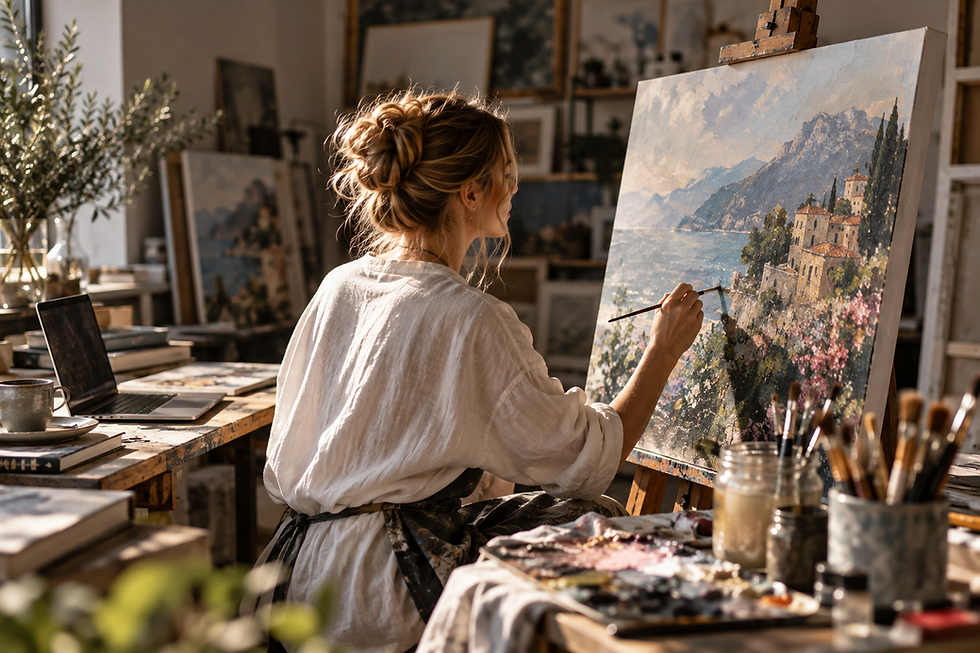
Instead of posting only a finished painting, artists can document the process — the blank canvas, initial sketch, first layers of paint, mistakes, changes, details, studio environment, and final signature.
Short videos and time-lapses can turn one painting into many pieces of content while also demonstrating that there is a real person behind the work.
For buyers, seeing a painting gradually appear on a physical canvas creates a completely different experience from seeing another finished image in a feed.
Physical Texture Matters More
One area where traditional painting has a natural advantage is texture.
Brush strokes, layers of oil or acrylic paint, imperfections in the canvas, reflections from varnish, and the physical depth of a painting are difficult to communicate through a simple digital image.
Artists selling online can therefore benefit from photographing their work differently.
Instead of uploading only a straight photograph of the entire painting, include close-ups of the surface, details photographed from an angle, images of the edges of the canvas, and photographs showing the artwork hanging in a real interior.
The goal is to remind the buyer that this is a physical object, not simply another JPEG.
Buyers Want a Connection With the Artist
Direct-to-collector relationships are becoming increasingly important.
An artist no longer has to rely entirely on a gallery to create that relationship. Instagram, TikTok, newsletters, personal websites, online marketplaces, and studio videos allow collectors to follow an artist long before making a purchase.
Someone might discover a painting today, follow the artist for six months, watch several new works being created, and only then decide to buy.
This changes the role of social media. It is not simply an advertising channel. It can become part of the collector relationship.
Limited Editions and Provenance Can Add Value
Scarcity becomes particularly interesting in a world of unlimited digital generation.
Original paintings naturally have scarcity: there is only one original.
Artists can emphasize this by providing signed certificates of authenticity, documenting the date and materials, numbering limited-edition prints, and maintaining clear records of individual works.
These details may seem small, but they help transform a painting from decoration into a collectible object.
Personalization Is Another Opportunity
AI makes generic imagery extremely easy to produce. Personalized physical artwork is different.
Commissioned paintings based on meaningful places, memories, people, pets, architecture, or personal stories can offer something that generic wall art cannot.
For many independent artists, commissions can therefore remain an important part of the business alongside sales of completed original works.
AI Can Also Be a Tool for Artists
The relationship between artists and AI does not necessarily have to be competitive.
Artists can use AI-powered tools for administrative and commercial tasks: generating ideas for social media content, preparing product descriptions, translating listings, organizing marketing campaigns, experimenting with interior mockups, or researching potential audiences.
That allows the artist to spend more time on the part of the business that cannot easily be automated — actually creating the work.
Artists should, however, be transparent when AI plays a meaningful role in the creation of artwork itself, particularly when buyers are purchasing a work because they believe it was created entirely through a traditional process.
Selling the Object, Not Just the Image
Perhaps the biggest change is psychological.
When images are abundant, an artist has to communicate why a particular physical object deserves to exist in someone’s home.
Show its scale.
Show its texture.
Show the studio.
Show the process.
Tell its story.
Explain what makes this particular piece different from every other painting you have created.
The internet may be filling with more images than ever before, but that does not automatically make original art irrelevant. Instead, it may push artists to emphasize qualities that digital abundance cannot easily reproduce: physical presence, scarcity, craftsmanship, provenance, and a direct connection between the creator and the collector.
In the age of AI, selling art may increasingly mean selling something more valuable than an image — evidence that a human being made something that exists only once.


Comments